It's new year resolution time, so news outlets are pushing articles about running. The BBC is currently running one called Nine tips to make running more enjoyable with insights from Christopher McDougall. I think a few of his points are questionable and I don't really think that the BBC should be repeating them without challenge, especially in an article aimed at inexperienced runners who won't have the experience to know whether to pay attention to them or not.
McDougall made waves in the running world when he released his 2009 book Born to Run. Amongst other things, it asserted that expensive and cushioned running shoes cause injury, and he is in the article above reiterating his belief that minimalism is best. I'm not going to get bogged down in details here and instead I'll quote Wikipedia:
Although he reports that the Berne Grand Prix questionnaire supports that opinion, [4] the study authors clearly say — "Occurrence of jogging injuries was independently associated with higher weekly mileage (P < 0.001), history of previous running injuries (P < 0.001), and competitive training motivation (P = 0.03)." [5] However they did find some correlation between higher shoe prices and increased injuries, but explicitly warn — "It is probably incorrect, however, to interpret this surprising finding to mean that more expensive shoes cause more running injuries…" [6]
— https://en.wikipedia.org/wiki/Born_to_Run_(McDougall_book)
Or in other words, the more miles you run, the more likely you are to get injured. And quite possibly, the more you run, the more likely you are to wear expensive, cushioned shoes. I don't see a huge mystery here.
Born to Run seemed to spark the barefoot/minimalist running trend of the era. You might remember seeing people in Vibram FiveFingers (shoes with toes). Some people found success with it, others found metatarsal stress fractures. But while recreational runners were trying their luck with minimalist shoes, sandals, and even fully barefoot, elite runners like Paula Radcliffe were going in completely the opposite direction and wearing 3d printed insoles created specifically for the runner's foot. Vibram later lost a lawsuit over their claims of health benefits. In any case, minimalist running shoes still exist, but have largely fallen out of fashion.
The high level argument presented by McDougall is that humans are designed by evolution to run, so why intefere with our natural mechanics by using clunky shoes? I tend to agree with his belief inasmuch that I feel humans are evolutionary optimised to traverse long distances on two legs. I'm not sure the rest necessarily follows.
A few points in this article are, in my opinion, not universally good advice and they are not presented with enough nuance for an inexperienced runner to be able to understand whether or not the points apply to themselves.
He says:
Consider thinner-soled shoes
Chris is a big proponent of running barefoot or as close as possible to that. “Anyone who really wants to control their body takes their shoes off,” he says. “A guy in a karate dojo isn’t showing up in cushioned shoes… even boxers wear the thinnest shoes possible. Why? Because they don’t want their feet squishing down in a bunch of mush. They want absolute control and mobility.”
The human body is amazingly good at running. In many cases it will find the ability to run even if the mechanics aren't good. For example, this can mean that someone with restricted ankle dorsiflexion (i.e. how much you can point your foot upwards) can still run, by finding the range of motion by twisting their foot or twisting their knee or raising onto their toes. It's a pretty good deal in a survival situation, less so for someone who wants to run a 5k a few times a week but keeps getting a sore knee. Most running shoes have a slight heel on them to reduce the amount of ankle dorsiflexion necessary by essentially bringing the ground up to the runner. You can argue that our reliance on modern shoes reduces our mobility, and you are probably right, but the fact is without sufficient mobility, minimalist running is more likely to cause injury rather than prevent it. If minimalist running works for you then great, but for anyone else, you should probably talk to a physio and get them to check your mobility before jumping into it; that thick heel on your shoe might actually be helping.
And comparing foot function in distance running to that of boxing or karate is clearly absurd.
Chris favours a short, quick running stride, running on the ball of the foot. “Think about any boxer you’ve seen skipping rope. Those guys look like they could skip rope until the end of time. The reason why is they’re basically bouncing on the ball of their foot and letting the natural elastic recoil of the body [do the work]. Your body is absolutely packed with rubbery tendons… rather than try to muscularly move that big hunk of leg around, just let that leg compress and bounce.”
The boxing comparison is still absurd, and running is not the same as skipping. Skipping is bouncing up and down. Running is pushing forwards. Bouncing in running is wasted energy.
Saying "run on the ball of your foot" sounds like a running cue. The thing with running cues is that they can be helpful for some people to shift their mechanics in the right direction, but detrimental if taken literally. I feel this one (literally) because I tend to run a bit too much on the ball of my foot for whatever reason, and my physio has spent much time trying to correct it. And, yes, I have had more than my fair share of foot and ankle injuries.
I think he's using this as a cue to stop overstriding. So let's talk about overstriding.
It's common for recreational runners to strike the ground well ahead of their centre of mass (overstride), which is bad because it exposes the runner to higher than necessary impact forces and also puts more demand on their leg's ability to stabilise themselves, both of which can lead to injury. An overstriding gait looks something like this:
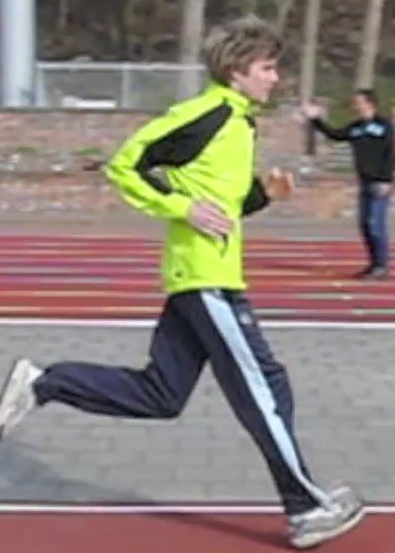
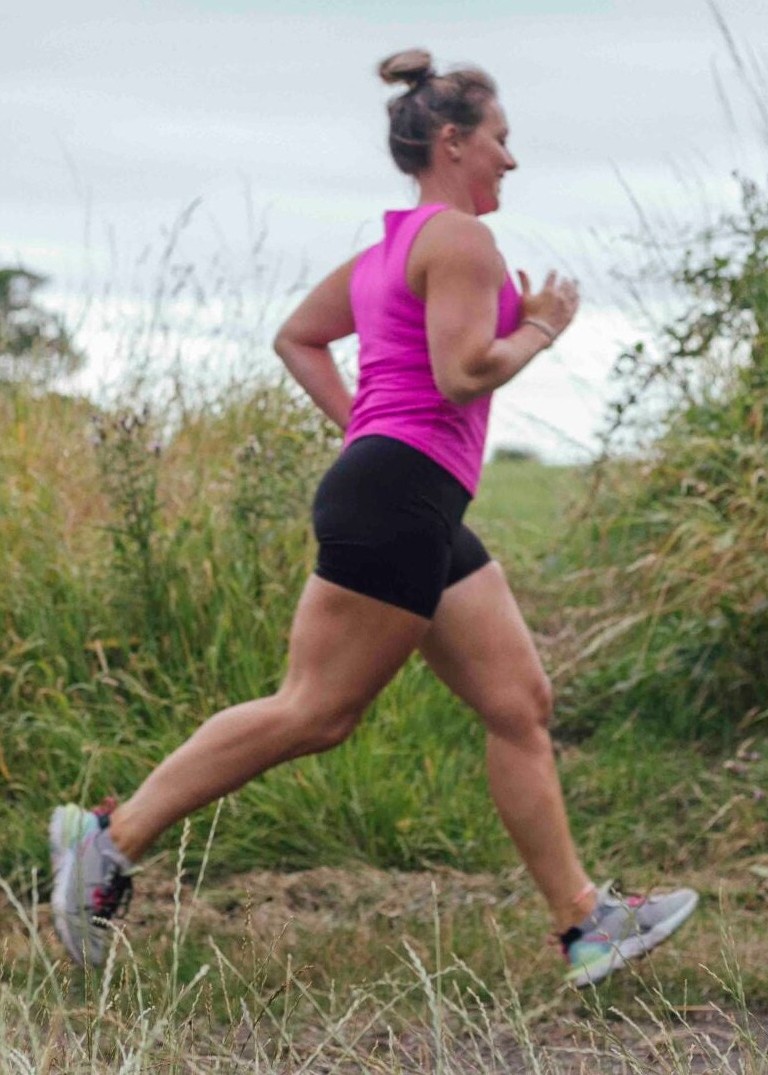
These images are a classic overstride, with the front leg extended straight out ahead just before impact.
I think this is what McDougall is trying to correct by mentioning the ball of the foot. But you can heel strike without overstriding (which is fine), and you can overstride without a heel strike (which is not). The problem is the overstride, not the foot angle. You shouldn't be trying to adjust your foot strike in isolation unless you have good reason to do so, because you'll probably just plantarflex your foot (i.e. point your toes downwards) and shift a lot of load to your foot, ankle and calves.
He also mentions a short, quick stride. For people who do overstride, shortening the stride slightly and increasing the cadence (number of steps per minute) is good advice, and more useful than trying to change foot strike. Interestingly, if your cadence is high enough and you are not overstriding, you probably will feel the impact more in the ball of the foot. But that's because of everything happening above the foot, not because you are trying to find the ground with the ball of your foot.
A good stride looks something like this, courtesy of Eliud Kipchoge. There is no such thing as universal perfect running form because we are all slightly different, but if there was, it would be Kipchoge's.
Compared to the overstriding images, Kipchoge's front leg is much more bent at impact, his front foot is closer to his hips, and he is likely landing a lot more gently too. Ironically, he will also have a longer stride length, because stride length comes from the push of the back leg, not reaching out with the front leg.
What about his foot strike? This is where it gets interesting. He makes contact with the ball of his foot, under his 4th and 5th metatarsals. But immediately after touching the ground, his foot is flat. So although he makes initial contact at the ball of the foot, he's absorbing impact with the whole foot, not just with the ball. But if you watch really closely, it looks like the foam compresses more under the midfoot than the heel, so it's probably fair to say his midfoot is taking more force than his heel. And this makes sense, he is not overstriding and he has good hip extension (leg moving out behind him), so his support leg extends much further out behind him than it does in front, meaning most of his ground contact time is spent with his weight above or in front of his foot, not behind. As such, it will probably feel to him like his weight is towards the front of his foot, i.e. on the ball. But it's subtle - an observer has to look very closely and in slow motion to see this; nobody would look at him at full speed and think he was running on the ball of his foot.
(Also note that the runner behind him appears to be heel striking, and this is perfectly normal even at the elite level - there isn't a single right way to run!)
Something else to note is that his front knee comes much higher than those of the overstriders. This comes about because he lifts his back leg higher, brings his foot up to his butt, and then drives the knee and foot though closer to his centre of mass. This is more efficient because of the physics of the situation (i.e. swinging your leg like a long pendulum needs more energy than swinging it like a short pendulum at the same speed), but that front knee drive also helps keep his front foot closer to his body when it's time to touch down.
Here are some of the frames of the moment of touchdown and just afterwards, where you can see the point of impact and how his foot flattens. I've also included a comparison of his thigh/knee position and the overstriding image above at what looks like a similar point in the gait cycle and a similar distance from ground contact.
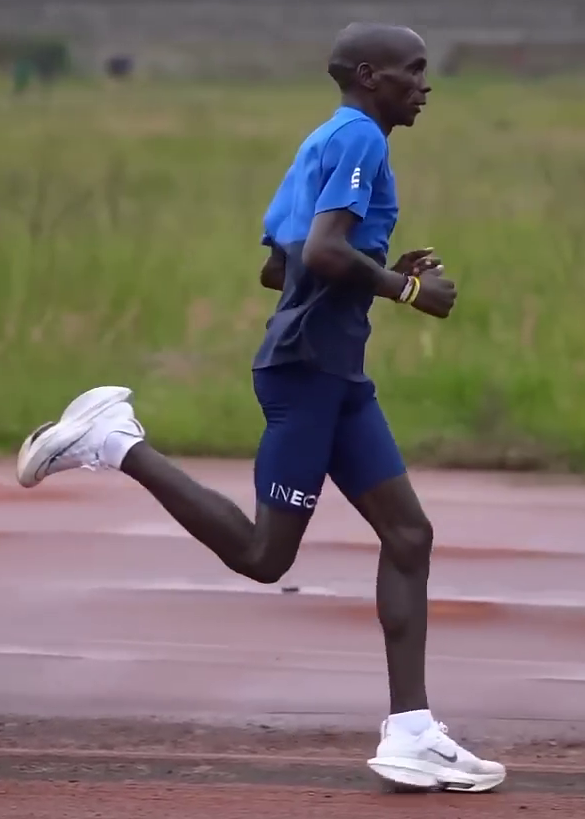
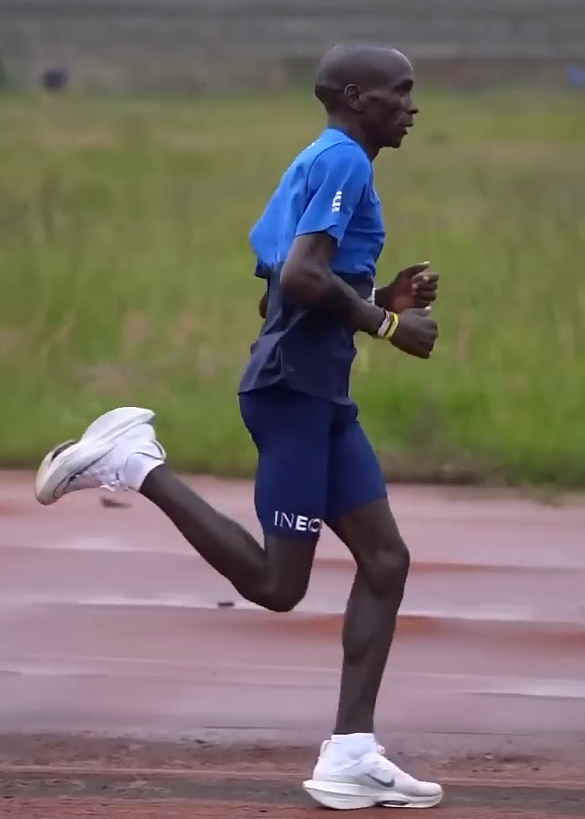
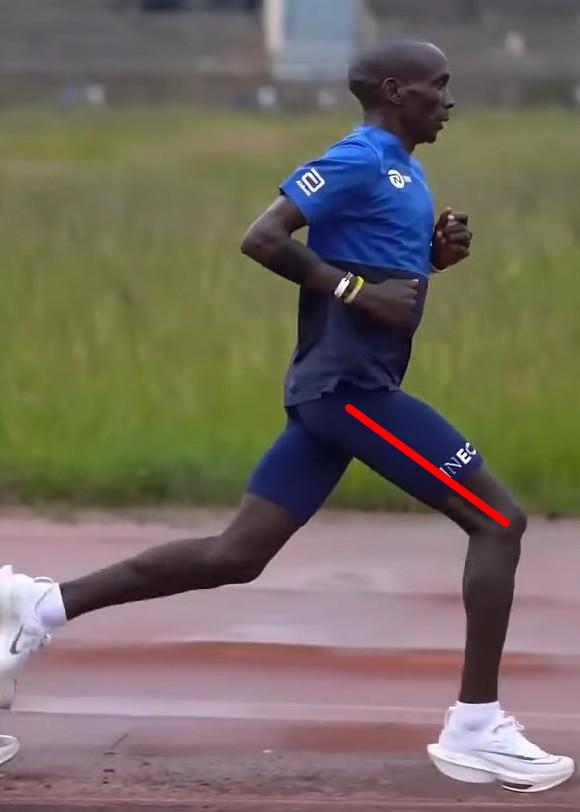
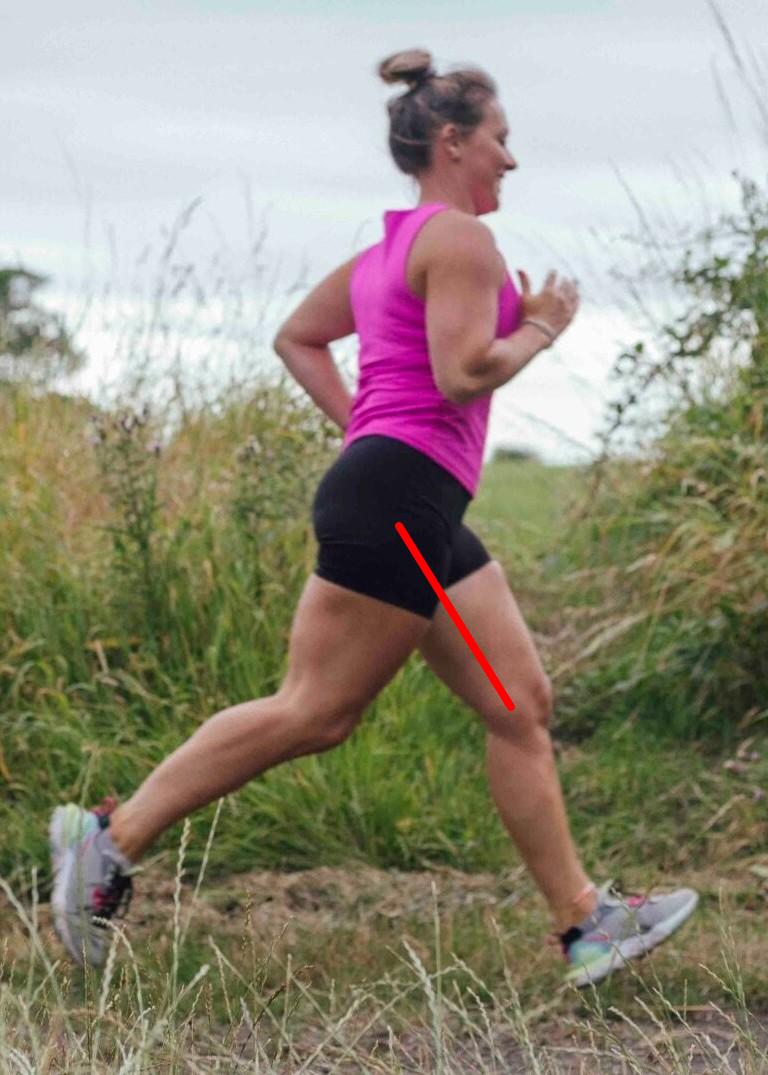
And a couple of side points: Firstly note the amount of foam under the heel - he is clearly not favouring minimalist shoes! Secondly, watch how little his head bobs up and down in the video - this shows how nonsensical the skipping analogy is.
The way Kipchoge is achieving all of this is partly though having an appropriate cadence, and partly postural. He is:
- Standing up straight
- Looking straight ahead, with his chest pushed slightly forward
- Keeping his hips forward, without letting them sink back
- After impact, he is starting to straighten his supporting leg through the hip and knee, pushing himself tall against the ground, through to a straight leg at toe-off, which then leads him into his knee drive.
These are all things that anyone can do to achieve good running form (although we probably still won't be able to keep up with Kipchoge). There are a few things that have worked well for me:
A good way to practise this is to run downhill at a comfortable pace while trying to keep your weight forward. If you get it in the right place, you will feel gravity pulling you down the hill and your cadence will likely come up to get your foot underneath you before you fall down. You will speed up, but the aim isn't to run quicker, it's to avoid breaking against gravity. If you aren't feeling like your legs had to suddenly start moving a lot faster to get underneath you then you're probably not getting your weight forwards and you may well be overstriding.
Another useful cue to think about is: do you feel like you're pushing or pulling? Kipchoge is pushing against the ground underneath and behind him to achieve propulsion. Not hugely forcefully, but he's definitely doing it. If you are overstriding, you will feel like your front leg is hitting the ground and then pulling you forwards, which is not efficient. You want to be pushing, not pulling.
So, to summarise, overstriding is when your foot hits the ground ahead of your weight. So there are two components: 1. Where is your foot?, and 2. Where is your weight?. The "run on the ball of the foot" cue is not wrong, but there is a lot of additional complexity to running gait and the ground contact point is one variable in a set of interdependent variables.
And if you can’t regularly link up with a running partner, run with a dog. You don’t even have to have your own dog. “If you’ve got a neighbour with a dog, borrow your neighbour’s dog,” says Chris. “If you know there’s a dog down the block you know isn’t getting enough exercise, take that dog out for a run. The dog will flip out and lose its mind and you will feel that joy of companionship.” Chris likes to run with donkeys, but you might find donkeys harder to come by in urban areas.
This is also not universally good advice. Not all dogs are endurance athletes and some will happily run to the point of exhaustion or injury. Dogs from working breeding lines might be happy to run all day, but you probably shouldn't be taking your shih-tzu out for a half marathon.